a primer on the 3rd Nilfgaardian War
Sep. 9th, 2021 01:25 pm![[personal profile]](https://www.dreamwidth.org/img/silk/identity/user.png) dragonlady7
dragonlady7details may be accurate, this is just my best effort, also i physically restrained myself with those text effects, you bet your ass i did that in full Photoshop, i don't know how to use Paint, witcher 3 spoilers
via https://ift.tt/3nkfrVV
So someone sent me a note, pertaining to the last chapter of Fit For Pearls https://archiveofourown.org/works/31289303/chapters/83210671 where I’d had Morvran explaining the political situation, asking me a few questions about specific scenarios, and from the questions I eventually realized that while I had a pretty clear idea of how the war ended up, the commenter did not. And it struck me that, well, it is sort of breezed-over in the game. It’s just presented as a bare fact that Nilfgaard has almost the whole North– well, everything up to the Pontar– and if you’re not paying attention it’s easy to overlook.
So here’s a basic summary of what has happened in the Third Nilfgaardian War, and how it ends if you’ve wound up on the Empress Ciri ending, which is what I’m taking as the foundation for the stories I’m writing. (No shade to the other endings, I just wanted to write about court intrigue and bookish lesbians; fair play if you’ve got other dreams, and more power to you.)
My sources are of course all Witcher 3, at this point. Emphasis added in quotations is mine. We have the backdrop of the books, which take place during the Second Nilfgaardian War, which ends in, mmm, a tactical retreat from the North, for Nilfgaard. As a part of that, there were many lovely stories of resistance from Lyria and Rivia, and so on. Thronebreaker, which is the story of Queen Meve’s resistance during the second war, has brought this idea back to the forefront of people’s minds. (In the books, we encounter that mostly because Geralt’s hansa runs into them trying to cross the Yaruga River, and winds up fighting on Meve’s side, hence Geralt getting knighted as Geralt of Rivia; it’s addressed briefly in Blood and Wine when Meve’s surviving son demands satisfaction since Geralt ran off after being knighted, and Meve took that as desertion. I’ll come back to him, though.)
So here’s the thing about Witcher 3: it is not about the war, and so the war is given extremely light-handed treatment. It is obviously going on, but there is absolutely no attention paid to how, except a few very minimal conversations, clearly just enough to hang the plot on. So it’s quite easy to miss the details, so I figured I’d just sort of collate them here for easy reference. All of this is pretty easily findable by just messing around in a search engine, if you’d like more information now that you know what to look for, and I’ll link to the map so you can look at place names in high-res.
So, in Witcher 3, we first get an explanation of How The War Is Going when Geralt is brought to see Emhyr at Vizima. Now, Vizima is the capital of Temeria, so the fact that the Emperor of Nilfgaard is sitting in the palace at Vizima speaks very eloquently as to the state of Temeria. (That, and how devastated the countryside is around White Orchard and in Velen, both of which are in Temeria.)
Ambassador var Attre is sent in to debrief Geralt, and gives us this snippet of dialogue:
Geralt: How is the war going? I mean, apart from the fact that Nilfgaard’s triumph is imminent.
Ambassador Var Attre: I assume this to be a private conversation. We’ve no witnesses, so let’s dispense with propaganda, even that shrouded in irony. Our offensive was going splendidly - until winter came. Aedirn was in such disarray that we encountered no resistance. We had reached the Pontar before the first snows.
He then goes off about the Kaedwen/Redania situation (which, if you haven’t played the games, is that Radovid of Redania attacked and conquered Kaedwen, which otherwise might have succumbed easily to Nilfgaard, and now controls both as a united front, and Nilfgaard is worried about it), but that’s it, a single line, that’s all Aedirn gets. Which, tragically, means that Lyria & Rivia don’t even get a mention– but, to get to Aedirn, that’s got to be the route Nilfgaard took.
In addition, later in the game, Geralt encounters Temeria’s own Vernon Roche, living in a cave as a literal underground resistance. (This cave is technically located in Redania, just west of Novigrad.) [image: image]
Roche says, “When Nilfgaard crossed the Yaruga, I dropped everything, threw it all away to hell, and rode for the front to fight the invader. Joined the 2nd Temerian Army under John Natalis. We were to stop the Black Ones’ advance along the Dol Blathanna - Mount Carbon line.” [image description: W3 screenshot featuring Vernon Roche, firelit, reciting the quoted line of dialogue above.] [image: image]
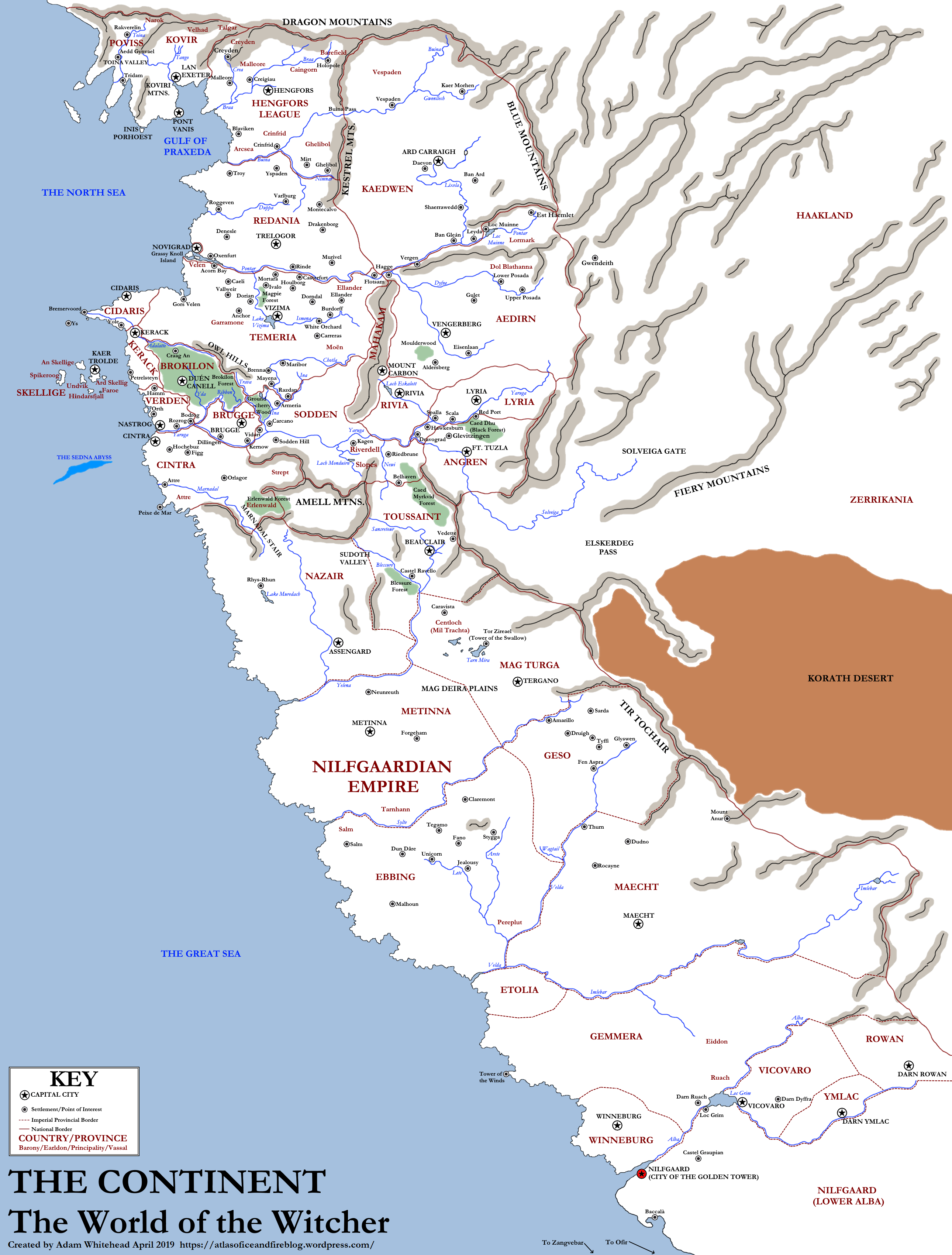
So I’ve taken the liberty of inserting a bit of a map [original source https://atlasoficeandfireblog.files.wordpress.com/2019/04/the-witcher-map-1.png] upon which I’ve circled Mt Carbon and Dol Blathanna, and drawn a dotted line between them to give some indication of what Roche could possibly be talking about. [image description: a map of the Continent, with crude yellow circles around the two locations, both of which are in Aedirn.]
This makes apparent a startling truth: neither of the endpoints of that line are in Temeria. This indicates that Temeria has to have invaded (or been invited into) Aedirn in order to attempt to stop Nilfgaard.
I know, this is kind of a lot to just– not mention, but. Remember Witcher 3 is entirely from Geralt’s POV (except when it’s Ciri’s in weird flashbacks), and Geralt was distracted and, we must conclude, not in a position to give a whole ton of fucks about what was going on in the greater world.
So the 2nd Temerian Army, we are told, was stretched across basically the dead center of Aedirn (for some fucking reason, IDK, nobody gets into it; I could see if they were level with Mt Carbon but in Temeria somehow, except why mention Dol Blathanna? No, that’s the other side of Aedirn; they have to be east of Mahakam for the whole thing. WHY. I don’t know), and managed to hold out for three days before Nilfgaard “smashed us to splinters”, says Roche, and since then, the 2nd was reduced to guerrilla resistance, and to learn the rest of Temeria’s status, we can return to the initial briefing with Ambassador var Attre, comfortably ensconced in the palace at Vizima:
Geralt: Hm… how do things look in Velen?
Ambassador: As bad as ever… perhaps worse. This land never flowed with milk and honey, and now it flows with blood. Armies have swept through it several times, trampling fields, looting granaries, burning villages. Famine grips the populace.
Geralt: Mhm. So how’s ruling that earthly paradise going for you?
Ambassador: Not well, to be honest. Our forces are spread thin as it is, and Velen is chiefly swampy forests that are difficult to control. We’ve had several patrols never return to their camps. Thus, we’ve temporarily delegated authority in this region to a certain Nordling, a former low ranking officer in the Temerian army, one http://orcz.com/index.php?title=Witcher_3:_Phillip_Strenger&action=edit&redlink=1Phillip Strenger. Better known by his nom de guerre, the http://orcz.com/Witcher_3:_Bloody_BaronBloody Baron. I advise you well - avoid him.
At any rate– this is what we know, then, of the Third Nilfgaardian War.
Nilfgaard apparently (? we don’t know, I’m assuming here) thought Temeria too tough a nut to crack from the south, so they crossed the Yaruga to the east, went up through Lyria and Rivia, smashed through Aedirn where Temeria had come to try to forestall them (for reasons we just don’t know! We aren’t told! We can’t know! Tight 3rd per POV babey!) and then– we actually don’t know whether Nilfgaard then wheeled west through Vergen and the Upper Pontar, and then came into Temeria that way around Mahakam, OR if once Temeria was weakened by its unexplained defense of Aedirn, Nilfgaard then found Sodden a soft enough target to launch a second attack that way. We don’t know! We know there’s a large Nilfgaardian army post in the south of Velen, and we know there was just a major battle in White Orchard, but those could have resulted from an attack from either the east or the south.
It’s possible there exist more materials on this, perhaps lists of what Nilfgaardian units we know about– if it’s the same unit that smashed through Aedirn that’s now stationed in Velen, there’s our answer, but if it’s a different one well that doesn’t necessarily mean anything.
(It’s possible that Nilfgaard crossed the Yaruga in several places, and Temeria’s resistance forced them eastward, and so Temeria’s army sort of accidentally wound up in Aedirn because that’s where the battle went, in a struggle to keep from being outflanked, and then Temeria’s army was pushed backwards into Aedirn, and by the time Roche caught up with them they’d been forced back as far as Mt Carbon? It’s possible! We don’t know. If so, it happened fast enough that Ambassador Var Attre could dismiss it as “we encountered no resistance”, unless he was being specific and the only resistance they countered was Temerian (who, Roche admits, they “smashed to splinters” in a matter of days). It’s… not necessarily contradictory or a plot hole, it’s just very obviously that our POV character does not care enough to seek out the entire coherent story.)
But what we know, for sure and for certain, is that Nilfgaard utterly controls the North as far as Redania and Kaedwen, and this expressly includes Aedirn, and presumably includes Vergen, and, sorry to say it, implicitly includes Lyria and Rivia because there’d be no way to have gotten to Aedirn without going through them. That is the line where they stopped, at the Pontar. [image: image]
[image description: a cropped map of the Continent with everything below the Pontar highlighted in yellow for “pretty sure” and orange for “probably”, indicating areas Nilfgaard isn’t mentioned as conquering but probably effectively has some measure of control over, with the white labeled “nope!” for expressly unconquered areas.]
Here’s our friendly map again, this time with the areas Nilfgaard controls highlighted. No, we know nothing explicit of Kerack, of Verden, Cidaris, everything off to the left there– it’s just not mentioned, but it’d be pretty unlikely that they find themselves uninvolved somehow. (Also Mahakam, nominally but never really under Temeria’s control, home to large numbers of dwarves with more power than anyone realizes– there’s no WAY Nilfgaard conquered that, but I also doubt they’re actively fighting against Nilfgaard in any way, nor would they be friendly with any human resistance fighters.) (IDK Dol Blathanna was already a vassal state of Nilfgaard’s, so I figured it hasn’t been reconquered, so I colored it orange, but who even knows how to categorize that.)
(Depending on the end of the game, whether Dijkstra lives or dies, whether Radovid lives or dies– well, for the Empress Ciri ending, all those things have to fall into place like dominoes, and she winds up controlling Redania and Kaedwen too, though I’m fuzzy on who is a vassal state and who just pays tribute. Which really leaves not a lot of white on that map.)
We can console ourselves that 1) there was a huge amount of cut content involving Iorveth and Roche which presumably would have delved into, I don’t know, literally anything about the underlying situations up north. Who knows? The imagination here is fertile, and 2) we meet Meve’s surviving son Anséis in the Blood and Wine expansion and he talks about his mother and if you snoop you can find this letter from her to him among his gear: [image: image]
[img description: a photo of the screen from a playthru of Witcher 3. Transcript: “Anséis’s Letter: Dear Son, Judging by your prolonged absence from the palace, I must conclude you have yet again rode off to join the knights’ tourney in Toussaint. Despite my asking you not to do so. Twice in a row you begged coin from me for the tourney, boasting with confidence you would win the tourney if you could but have a new horse, armor, and sword. Twice in a row I gave in to your pleading. This year I forbade you from going, yet I see I merely rule my realm, not my own son. Enjoy yourself, but know that your monthly allowance ends today. No matter your place on the podium. I am sending a messenger with this letter to Beauclair and trust he will find you there. Your Loving Mother, Meve” end transcript]
So, Meve still rules, despite Nilfgaard having rolled over her; we can presume then that she made some sort of arrangement with them. Because there’s just no way that Nilfgaard somehow tore through Aedirn in a matter of days, on the way to Temeria, without having passed through Lyria and Rivia.
We can assume that likely Nilfgaard has established vassal states, similarly retaining the old heads of state, in other countries as well, and that’s what I’m going with. i do believe some of that is made explicit in game dialogue toward the end of the game, as we find out the end-state after Radovid is killed in the endings where that happens, etc. But, the point I’m making with all this, is that Nilfgaard pretty convincingly controls most of the North by the beginning of Witcher 3.
At any rate– this is a more in-depth discussion than I put into Morvran’s mouth, but to those who haven’t played the games, perhaps this is a useful bit of information.
(h/t to akilah12902 https://tmblr.co/mmG9gp3S698rFJImW-pcxgg for the
shot of Anséis’s letter!)
(Your picture was not posted)